









You're staring at a Monday morning that already feels too full. One person is sketching this week's campaign, another is resizing a carousel for LinkedIn, a writer is trying to make a 30-second script sound human, and the community manager is clearing weekend comments before lunch. Nothing is broken, but the work isn't connected, and that's exactly how teams end up with scattered ideas, mismatched formats, and an analytics review built on guesswork.
The problem usually isn't talent. It's that social media management and content creation get handled like separate jobs instead of one operating system with moving parts. The brands that stay consistent don't rely on heroic individual effort, they build a system where planning feeds production, production feeds distribution, distribution feeds engagement, and engagement feeds the next round of decisions.

The Operating System Behind Every Active Brand
A campaign can look busy and still fail without notice. The strategist chooses the priority, the creator turns it into assets, the distributor adapts them for each network, and the community manager keeps the conversation alive after publishing. Clear handoffs connect those jobs, so the team can work quickly without making every decision from scratch.
Why stitched-together work beats heroics
Lean teams struggle when one person has to remember the entire process. An idea may reach a draft, then stall because nobody owns design. A post may go live, yet receive no replies because community follow-up was never assigned. Without that feedback, the next plan rests on assumptions.
Consistency is therefore a process issue before it becomes a creative issue. The team needs a visible path from idea to asset, from asset to distribution, and from audience response back to planning.
The scale of social makes that discipline more important. Global social media usage has reached roughly 5.79 billion identities in 2026, and people spend about 18 hours and 36 minutes per week on social and video feeds. Publishing cadence, format choice, and timing therefore belong in the operating plan, not in last-minute decisions (HubSpot social media marketing report).
Practical rule: if a task happens every week, assign it an owner, give it a checklist, and place it on the calendar.
What the system has to do
A workable system answers a small set of direct questions:
- Who decides what gets made?
- Who turns the idea into an asset?
- Who adapts it for each network?
- Who monitors replies and questions?
- Who decides what deserves another version?
Those answers give a lean team a repeatable route through planning, production, distribution, engagement, and review. New campaign ideas can enter the same workflow instead of creating a new process each time. The result is a steadier publishing rhythm, clearer accountability, and enough room for people to protect the brand's human voice.
What Social Media Management and Content Creation Mean
A social team can produce excellent work and still struggle if planning, production, publishing, and audience response sit in separate lanes. Social media management moves the system. It covers channel strategy, calendars, scheduling, community response, governance, and reporting. Content creation supplies the assets through ideation, scripting, design, filming, editing, and packaging for each network.
The distinction becomes clear in everyday scenarios. A designer may create polished posts that miss their publishing window. A social manager may maintain a reliable calendar filled with assets that no longer earn attention. One role keeps the train on the track; the other builds what the train carries. Sustainable output requires both roles to connect through shared briefs, deadlines, and feedback.
The current workflow also reflects a shift toward faster, more varied production. In the 2026 reporting cycle, 94% of marketers said they use AI in some part of their workflow, while 77% said authenticity matters more than production value (HubSpot social media marketing report). Meanwhile, 91% of businesses use video as a marketing tool, 82% say it delivers good ROI, and 51% say the optimal video length is 30 to 60 seconds (DesignRush social media marketing statistics).
For a lean team, those findings point to a practical operating model: create a strong core idea, adapt it for each platform, and keep the final version recognisably human. A single insight might become a short video, a carousel, a written post, and a reply prompt, with each format serving the habits of its audience.
| Dimension | Social Media Management | Content Creation |
|---|---|---|
| Primary job | Orchestrates the system | Produces the assets |
| Main output | Calendar, scheduling, replies, reporting | Scripts, videos, graphics, captions |
| Key question | When, where, and how should we publish? | What should we make and how should it look or sound? |
| Failure mode | Great content goes unpublished or unnoticed | Strong ideas never become usable assets |
| Success signal | Consistent execution and useful insights | Assets that feel native and worth sharing |
A simple rule keeps ownership clear: management moves the work, while creation makes the work. Shared checkpoints connect them without making every person responsible for every task.
The Five-Stage Workflow From Idea to Insight
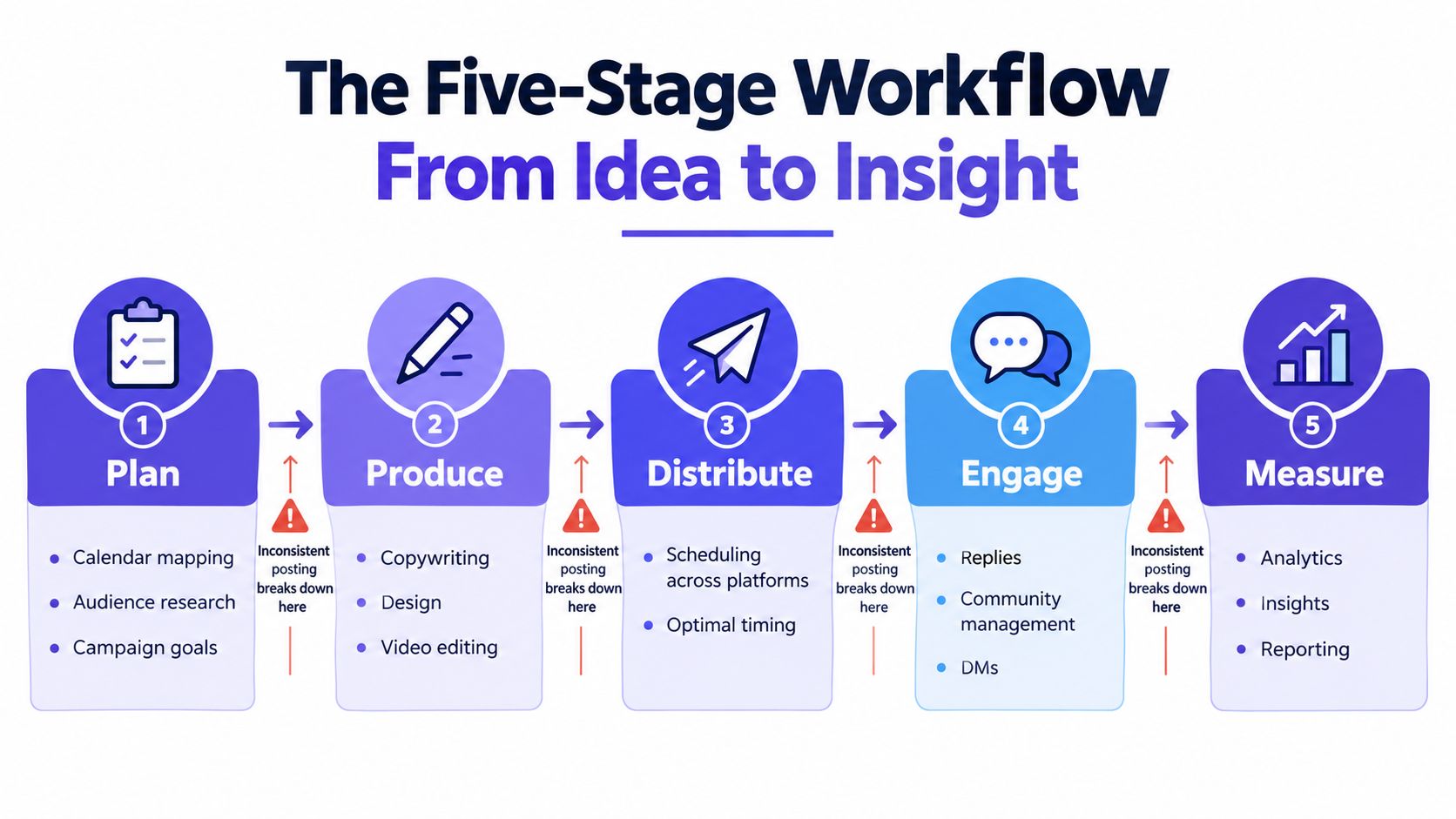
Most inconsistent posting breaks at the seams between stages. The fix is to make each stage visible, with a clear input, a clear owner, and a clear output.
Plan
Planning starts with audience research, content pillars, channel selection, and an editorial calendar. The output is not “ideas,” it's a schedule with owners, deadlines, and a reason for each post to exist. If a topic doesn't fit a pillar or a channel, it probably doesn't belong in the queue yet.
Produce
Production turns the plan into actual assets. That means scripts, clips, captions, carousels, graphics, and edits, all shaped by a brief that specifies the hook, format, length, and call to action. Teams often stall here because the brief is vague, so the creator keeps guessing at the final shape.
Distribute, Engage, Measure
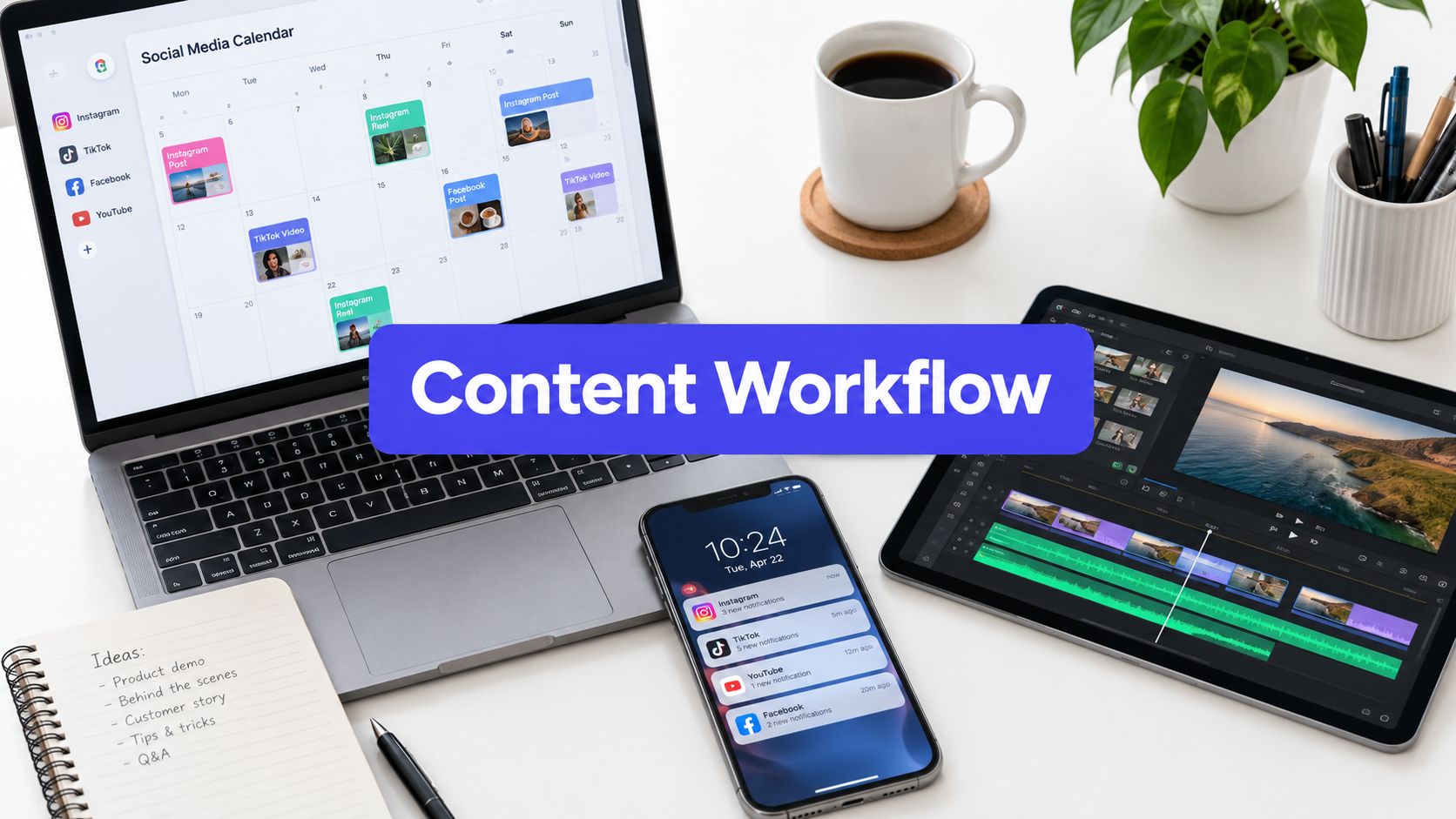
Distribution adapts the asset for each network and schedules it through a publishing tool. Engagement is the inbox and comment queue work that starts after publish, where speed and tone matter as much as the post itself. Measurement closes the loop with reach, watch time, saves, sentiment, and conversions, then feeds the next planning cycle.
A useful way to think about the system is this. Planning tells you what to make, production makes it real, distribution places it where people expect it, engagement keeps the signal alive, and measurement tells you what to do again. When one stage is weak, the whole chain slows down.
Matching Format and Timing to Each Platform
The same asset won't perform the same way everywhere. A LinkedIn audience doesn't arrive expecting the same thing as a TikTok audience, and a Pinterest user isn't browsing like someone scrolling Facebook. That's why cross-network cadence has to be tuned by platform, not copied and pasted.
What the benchmarks suggest
Buffer's 2026 benchmark data shows a median engagement rate of 4.3% for Instagram, with Reels as the best-performing format, 4.86% for TikTok with video as the top format, 6.5% for LinkedIn with carousels as the best post type, and 3.6% for Facebook with pictures (Buffer social media benchmarks). The point isn't that one platform is “better,” it's that format choice and timing are materially different by network.
That's why the same core idea needs different packaging. A long video can become a short vertical hook for Reels, a tighter vertical cut for TikTok, a quote card or document post for LinkedIn, a text-native take for X, and a thumbnail-led YouTube short. Each version respects the way people use that platform.
Keep the message stable, change the wrapper.
A simple selection rule
If you're unsure where to spend effort, choose fewer posts and make the format feel native. People forgive lower volume faster than they forgive content that feels off-platform. A post that fits the network usually earns more attention than a busy calendar full of mismatched assets.
This is also where scheduling discipline matters. One cross-network calendar looks efficient on paper, but platform-specific behavior makes it risky in practice. Teams usually do better when they treat each network as its own lane, even if the underlying idea came from one source asset.
Scaling With AI Without Losing the Human Voice
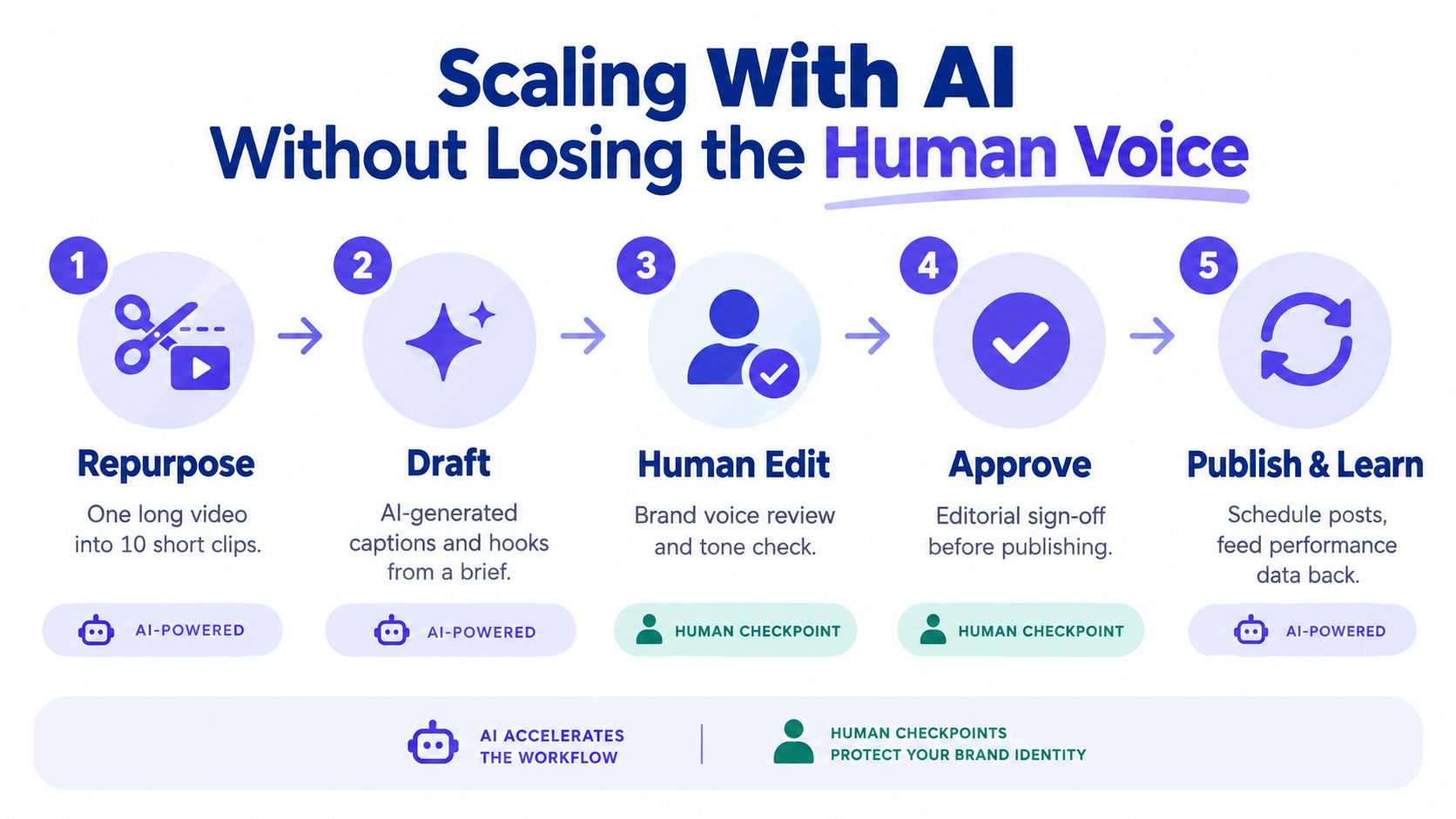
AI is useful in social because it removes repetitive work, not because it can replace judgment. The highest-value use cases are the ones that turn one strong asset into many publishable variations, then leave the final voice check to a person. That's where teams gain speed without flattening the brand.
Where AI helps most
AI can repurpose a long video into short clips, transcribe a webinar into quote cards, draft captions from a brief, suggest hashtags and alt text, and summarize comment sentiment for the community manager. It's strongest when the source material is already good and the task is repetitive. It's weaker when the work needs taste, restraint, or a nuanced brand voice.
The risk is not speed, it's sameness. Recent research on AI-assisted social content says practitioners still struggle with formulaic tone, shallow emotional resonance, inconsistent visual detail, and brand identity dilution, and that quality depends on precise prompting plus rigorous human editing (IBIMA Publishing research).
The guardrails that keep output usable
A sensible workflow uses a locked style guide, a human review checkpoint before scheduling, and a small library of approved voice anchors. Those anchors can be signature phrases, banned phrases, and a few tone examples that show what “on brand” really means in practice.
AI should draft the repeatable parts. People should protect the meaning.
For teams building this into a tool stack, one useful reference is an AI for social media management workflow guide. PostSyncer also fits here as one option for teams that want to generate captions, images, and short videos, then move them into a scheduling and approval flow from one workspace.
Team Roles, Approvals, and Multi-Brand Workflows
Strong output depends on clear ownership. A strategist defines positioning and channel mix, a content lead protects editorial standards, a creator or designer produces the assets, a community manager handles engagement, a paid media owner amplifies winners, and an approver signs off when the work has legal or brand risk.
A clean approval path
The simplest approval flow is draft, internal review, brand or legal check if needed, scheduled with buffer, then published and handed to the community manager. That buffer matters because last-minute edits are where mistakes slip through, especially when more than one person is touching the same post. A shared workspace helps, but the bigger win is a workflow where every step has a clear gate.
For teams that need a template, an approval workflow template can help standardize the handoff between draft and publish. The same logic applies to influencer work, where the collaboration, approval, and posting sequence needs the same kind of structure described in Social Cloud's influencer marketing workflow guide.
How multi-brand teams avoid cross-contamination
Agencies and in-house teams running several brands need to separate the platform layer from the brand layer. The platform layer is the login, workspace, and publishing tool. The brand layer is the voice, asset library, calendar, and approver tied to one client or one brand family.
That separation is what lets a single team handle several calendars without mixing assets or tone. The common mistake is giving everyone access to everything. The smarter move is to give broad workflow access and narrow brand access.
Why Raw and Community-Led Content Often Beats Polished
Perfectly produced content can still feel distant. A phone-shot story, a screenshot reply, an employee POV clip, or a customer post often feels more believable because it looks like something a real person would share. That credibility matters when audiences are tired of content that looks overworked.
What feels native now
The current conversation around social fatigue points toward authenticity, community, and raw formats. Industry commentary for 2025 notes the growing traction of unfiltered or employee-led content, and it also highlights TikTok UGC as 55.7% of content and says 18% of creators earn primarily from UGC (Loomly social media trends). Those numbers reinforce a practical point, audiences are increasingly comfortable with content that feels less polished and more direct.
That doesn't mean polish is useless. It means polish is one ingredient, not the whole meal. A brand feed gets stronger when it mixes flagship assets with community-led posts, customer proof, and lightweight reactions that feel current.
| Signal | Polished Studio Content | Community-Led Content |
|---|---|---|
| First impression | Controlled and refined | Immediate and personal |
| Comment depth | Often lighter unless the topic is strong | Often deeper because it invites reaction |
| Trust signal | Brand-managed credibility | Human credibility and lived experience |
| Production cost | Higher | Lower |
| Shareability | Strong for launches and hero campaigns | Strong for relatable moments and proof |
If you want a practical playbook for sourcing and shaping this kind of material, Viral.new's UGC strategy guide is a useful reference point. You can also structure a repeatable approach with an UGC campaigns guide so requests for content don't feel transactional.
A better way to ask for content
Ask for specific moments, not vague “testimonials.” Invite customers to show how they use the product, what surprised them, or what they wish they had known earlier. That kind of prompt produces more usable material and makes the creator feel like a contributor, not a vendor.
Putting the System Together and Choosing Your Next Step
The whole system works because each part feeds the next. Planning gives production a target, production gives distribution something usable, distribution creates engagement, engagement surfaces signals, and those signals shape the next plan. If one stage is weak, the rest of the chain absorbs the drag.
A fast workflow audit
Start by naming the weakest stage in your current setup. Maybe ideas are good but production is slow. Maybe publishing is reliable but engagement is ignored. Maybe the calendar is full but reporting doesn't change future decisions.
Then check for missing roles. A lot of bottlenecks are really ownership problems in disguise. If one person is writing, designing, scheduling, replying, and reporting, the workflow isn't lean, it's overloaded.
The best process is the one the team can repeat next week without improvising.
Match the system to the team size
Solo creators usually need a calendar, a repurposing template, and a simple approval habit before posting. In-house teams benefit from formal briefs, clear role ownership, and a review layer that prevents rushed uploads. Agencies need multi-brand workspaces, client approvals, and reporting that keeps each account separate.
A good 90-day checklist is straightforward. Define an AI policy. Set a UGC sourcing cadence. Decide how often analytics gets reviewed. Lock the approval path. Pick the formats you'll repeat instead of constantly chasing novelty.
When the operating system is clear, social stops feeling like a daily scramble and starts acting like a production engine. If you want a workspace that helps teams plan, publish, collaborate, and measure in one place, visit PostSyncer and see how its scheduling, AI content tools, approvals, and analytics can support a more consistent social media management and content creation workflow.