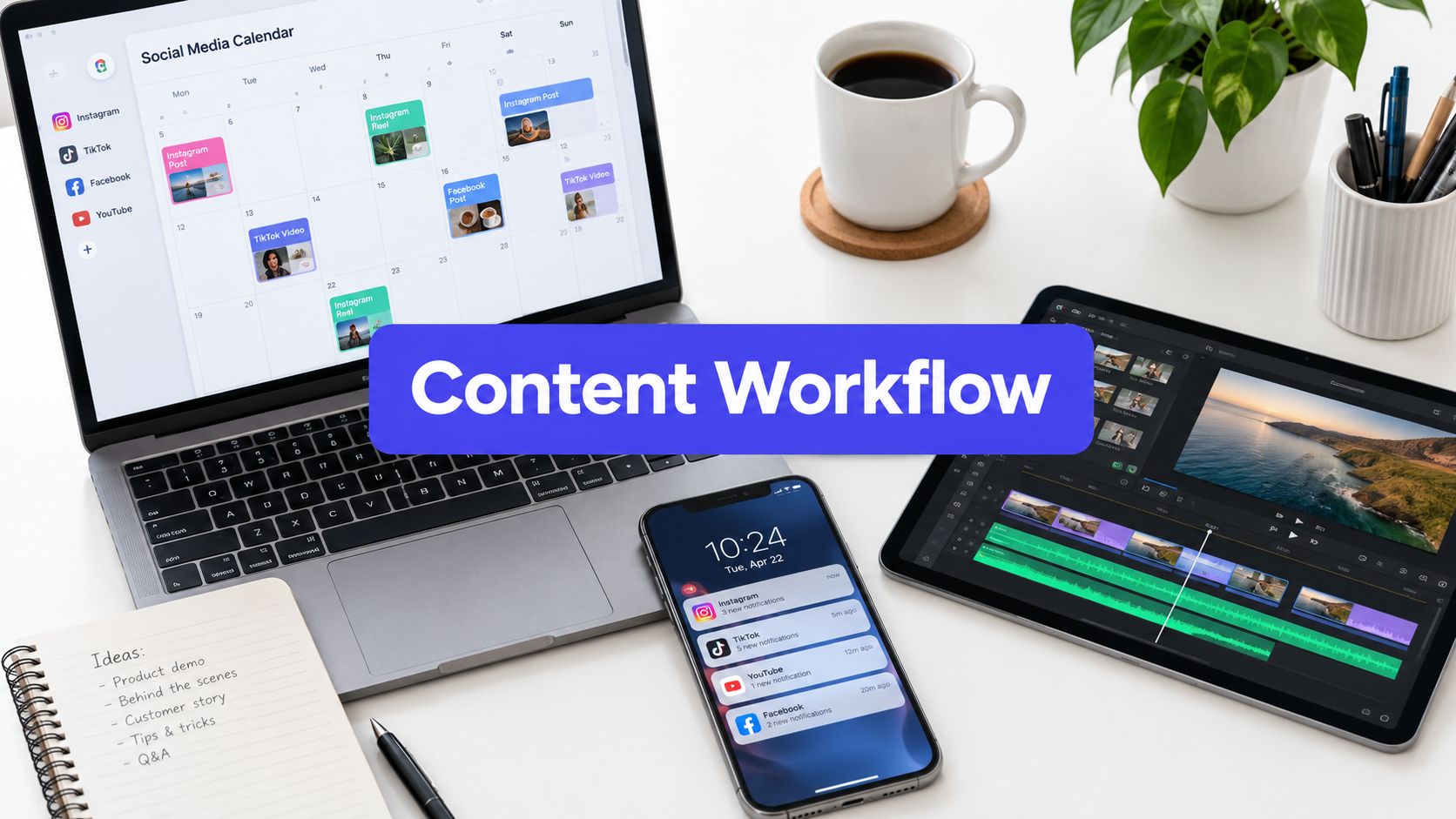










A social media dashboard is your single source of truth for everything social. It brings content scheduling, audience engagement, and performance analytics from all your different networks into one central hub.
Think of it as the mission control for your brand's online presence. Instead of jumping between a dozen tabs and apps, you get a clear, organized workflow that turns chaos into clarity.
What Is a Social Media Dashboard?

Ever feel like you’re trying to conduct an orchestra where every musician is in a different room? You’ve got a violinist on TikTok, a cellist on Instagram, and a drummer on LinkedIn. That's exactly what managing social media feels like without the right tool.
A social media dashboard is the conductor's podium. It brings every platform—Facebook, X, Instagram, LinkedIn, TikTok, you name it—into one cohesive space.
It's a specialized tool that connects to all your accounts so you can stop logging into five different apps just to post content, reply to comments, and check your stats. You do it all from one place. Simple as that.
From Manual Chaos to Strategic Control
The difference between managing social media manually versus with a dashboard is night and day. A social dashboard does for your online presence what a good Business Overview Dashboard does for an entire company—it consolidates everything you need to see. You'll move from just reacting to notifications to proactively building a real strategy.
And let's be honest, you need that strategic edge more than ever. The social media market is projected to jump from $208.08 billion in 2025 to a staggering $234.34 billion in 2026. That’s a 12.6% growth rate in a single year.
This is why a tool like PostSyncer is such a game-changer. When you're trying to stand out on platforms like Facebook, with its 3.07 billion users, you can't afford to waste time. A single workspace gives you the real-time insights you need to spot what's working and double down on it.
To really see the difference, let’s look at the day-to-day reality of managing social media accounts.
Managing Social Media With vs Without a Dashboard
The table below breaks down just how much work a dashboard takes off your plate. It’s the difference between working harder and working smarter.
| Task | Without a Dashboard (The Hard Way) | With a Dashboard (The Smart Way) |
|---|---|---|
| Posting | Log in to each platform one by one to manually upload and publish content. | Schedule posts for all your accounts from one visual content calendar. |
| Engagement | Frantically jump between app notifications and DMs, inevitably missing comments. | Manage every comment and message from a single, unified social inbox. |
| Analytics | Export data into messy, separate spreadsheets to try and compare performance. | See unified, real-time analytics with reports that compare channels side-by-side. |
As you can see, the "hard way" is not just inefficient—it's unsustainable.
A social media dashboard isn't just a nice-to-have; it's a core tool for any modern brand. By centralizing your work, you get back hours of your time, gain clear insights into what your audience wants, and can finally build a cohesive strategy that works everywhere.
Once you have all that data in one place, the next step is knowing what to do with it. You can learn more about interpreting your metrics in our guide to social media analytics and reporting.
The Essential Features of a Modern Dashboard

Let's get one thing straight: a real social media dashboard isn't just a place to dump your posts and schedule them. It’s the command center for your brand's growth. It’s what separates throwing content at the wall from executing a smart strategy that actually moves the needle.
The best tools are built around features that give you back your time, boost the quality of your content, and show you exactly what’s working. They provide a single source of truth for your entire social media operation.
And frankly, you need one. By 2026, platforms like Facebook and Instagram are each projected to hit 3 billion monthly active users. TikTok will be cruising past 1.5 billion, while newcomers like Threads could easily rocket to 400 million.
With over 60% of product discovery now happening on social media, you simply can't afford to manage these channels as separate islands. A good dashboard brings it all together under one roof, a critical point detailed in these social media statistics.
Unified Scheduling and a Visual Calendar
The absolute bedrock of any great dashboard is the power to plan, create, and schedule posts for all your networks in one spot. This isn't just about being efficient; it's about being strategic. A visual content calendar gives you that 30,000-foot view of your entire publishing plan.
Imagine seeing all your upcoming TikToks, Instagram Reels, LinkedIn articles, and X posts laid out for the month ahead. That clarity is a game-changer. It lets you:
- Spot Content Gaps: Instantly see where your schedule looks a little thin and needs some love.
- Ensure a Balanced Mix: Check that you’re not just posting sales pitches, but also sharing educational, fun, and behind-the-scenes content.
- Coordinate Campaigns: Seamlessly line up posts across different platforms to support a single marketing launch.
Tools like PostSyncer push this even further by supporting over 12 networks, including the big players like TikTok and Instagram, but also up-and-comers like Threads, Bluesky, and Mastodon. This means you can show up where your audience is without piling on more work.
A visual calendar transforms social media management from a reactive, chaotic task into a proactive, strategic operation. It allows teams to think weeks and months ahead, ensuring consistency and quality.
Seamless Team Collaboration
For any agency or marketing team, collaboration is everything. Without the right setup, creating and approving content turns into a nightmare of endless email chains, Slack messages, and confusing spreadsheets. A modern dashboard completely eliminates that bottleneck.
Look for key collaboration features like:
- Approval Workflows: Team members can draft posts and submit them for review. Managers can then approve, reject, or drop feedback right there in the platform. No more back-and-forth.
- Content Labels & Categories: Organize everything by campaign, content pillar, or status (like "Draft," "Needs Review," or "Approved"). It keeps the chaos organized.
- Multi-Workspace Management: This is a must for agencies. You can create separate, secure workspaces for each client, keeping all their content, analytics, and branding neatly tucked away.
These features are your defense against typos, off-brand posts, and general confusion. They empower your whole team to contribute without you having to play traffic cop.
AI-Powered Content Creation and Repurposing
Let’s be honest, creative burnout is real. The most forward-thinking dashboards now bake in powerful AI to help you crush writer's block and speed up content creation. This isn’t about replacing you; it’s about giving you a seriously smart creative partner.
Instead of staring at a blinking cursor, you can give a tool a simple instruction and watch the magic happen.
For example, PostSyncer’s AI Content Agent can take a simple prompt, a link to your latest blog post, or a product page and instantly spin up dozens of unique social media posts. It writes clever hooks, compelling captions, and relevant hashtags that are actually tailored for each specific network.
Even better, AI is a complete game-changer for repurposing. Imagine pasting a link to a 10-minute YouTube video and having an AI tool automatically find the best parts, trim them into viral-ready short clips, and add captions. Just like that, one big piece of content becomes a week’s worth of posts, maximizing the value of everything you create.
Translating Data Into Actionable Growth
Let’s be honest, the days of chasing vanity metrics like raw follower counts are long gone. Today, a powerful social media dashboard is your command center—it’s where you turn a flood of raw data into a real, strategic weapon for business growth. It’s all about moving past simply reporting numbers and starting to make smart, informed decisions.
Think of your dashboard's analytics as an X-ray of your audience's mind. Instead of just guessing what content resonates, you see it laid out in black and white. This clarity means you can stop wasting time and money on posts that fall flat and go all-in on what actually works.
The goal isn't just to be on social media anymore; it's to be effective. Whether you’re an e-commerce brand driving sales or a B2B company hunting for leads, every single post should have a purpose. Your dashboard is the tool that proves it.
From Metrics to Meaningful Insights
Analytics can feel like a tangled mess, but a good dashboard is designed to cut through the noise. It organizes all that data into simple, understandable trends, shining a spotlight on what truly matters for your strategy.
For instance, seeing a sudden spike in engagement on a post is great, but it’s more than just a win—it’s a clue. A dashboard lets you dig into the why behind the numbers.
- Was it the format? Maybe a Reel outperformed a static image.
- Was it the topic? Did the hook in your caption grab more attention?
- Was it the timing? Did you post at a different hour than usual?
A real-time dashboard shows you these patterns as they unfold, letting you adapt your strategy on the fly instead of waiting for a monthly report. That kind of agility is what separates the brands that grow from those that stagnate.
A social media dashboard translates data points into a clear narrative about your audience. It tells you what they love, what they ignore, and where your biggest opportunities for growth lie.
Once you understand that story, you can build a content strategy that hits the mark, time and time again. It’s about listening to what your data is telling you.
Focusing on Platform-Specific Performance
You wouldn't use the same script for a movie and a play, right? The same goes for social media. Each platform has its own audience and its own rules, and your strategy needs to reflect that. Your dashboard is absolutely essential for spotting these platform-specific trends and putting your creative energy where it will make the biggest impact.
And trust me, the performance differences can be huge. Just look at the latest benchmarks from the 2026 social media benchmarks report—TikTok leads the pack with a massive 3.70% engagement rate, while Facebook comes in at just 0.15%. That doesn’t mean you should ditch Facebook, but it’s a clear sign that a video that goes viral on TikTok might need a completely different spin to work anywhere else.
A smart social media dashboard like PostSyncer makes this kind of analysis dead simple. It shows you what’s working where. For example, it’s clear that short-form video delivers the highest returns—a staggering 41%—and empowers you to double down on that format. For an agency managing clients on a fast-growing platform like Threads, which has already hit 400 million monthly users, this kind of unified insight is a total game-changer.
Key Social Media Metrics to Track in Your Dashboard
To really turn your data into growth, you need to be tracking the metrics that are directly tied to your business goals. Your dashboard helps you organize and monitor these vital signs so you always know where you stand.
Here are the core metrics you should have your eyes on.
| Metric | What It Measures | Why It's Important |
|---|---|---|
| Engagement Rate | The percentage of your audience that interacts with your content. | This is the number one sign that your content is actually connecting with people and building a community. |
| Audience Growth Rate | How quickly you are attracting new, relevant followers. | A steady growth rate shows your brand is staying relevant and expanding its reach to new potential customers. |
| Click-Through Rate (CTR) | The percentage of viewers who click a link in your post or bio. | For anyone selling a product or service, this metric directly shows how well your content is driving traffic and leads. |
| Optimal Posting Times | The days and hours when your audience is most active and engaged. | Posting at the right time gives your content the best possible start, which is a huge factor for algorithm performance. |
By checking in on these metrics regularly inside your dashboard, you create a powerful feedback loop. You can see the immediate impact of your experiments—like trying new content pillars or posting schedules—and adjust your strategy based on cold, hard data.
This whole process is even easier when you have a good framework. You can build your own using our guide on creating a social media analytics report template.
How Different Teams Win with a Dashboard
A social media dashboard isn't a one-size-fits-all gadget. Its real power is unlocked when it’s put to work solving the specific problems that different teams face every single day. The value isn't just about having all your posts in one place—it's about turning the tool into a growth engine built for your exact needs, whether you're a solo creator or a global agency.
At its core, the function is simple: turn scattered, messy data into smart, actionable decisions. But what those decisions look like, and the goals they serve, change completely depending on who’s in the driver's seat.
This flow, from raw data to real-world growth, is the fundamental process every team uses, just in their own unique way.

As you can see, the dashboard acts like a central processor. It pulls in data points from all over, refines them into clear insights, and ultimately, helps you grow faster. This cycle is precisely what makes it such a non-negotiable tool for any modern marketing effort.
Small Businesses Punching Above Their Weight
If you're a small business owner, you know your most precious resource is time. Juggling sales, customer service, and marketing is a constant balancing act, and a social media dashboard can feel like cloning yourself. It automates the tedious, time-sucking tasks that eat up your day.
Instead of manually logging into five different apps, you can map out and schedule an entire week of content in just 30 minutes. That efficiency isn't just about saving time; it's about leveling the playing field. It lets a small shop maintain a professional, consistent online presence that can go toe-to-toe with much bigger competitors.
- Cost Savings: Consolidating your tools means you can ditch several different subscriptions.
- Brand Consistency: A single calendar ensures your voice and message are the same everywhere.
- Direct ROI: Easily track which posts are driving clicks and traffic to your site, proving what’s actually making you money.
Digital Agencies Managing Brands at Scale
For agencies, business success comes down to two things: managing multiple clients without chaos and proving your value. A dashboard with multi-brand workspaces is an absolute must-have, giving you a secure, organized hub for each client’s content and analytics.
But the real magic for agencies is in the workflow. Features like streamlined client approvals can transform a messy chain of emails and spreadsheets into a clean, simple, and trackable process—all inside the platform. This saves an incredible number of hours and, more importantly, prevents costly mistakes.
A social media dashboard gives an agency the structure to scale. It provides the systems needed to onboard new clients seamlessly and deliver consistent, high-quality results without drowning the team in administrative work.
Ultimately, it helps you shift from being just another service provider to a true strategic partner. You can deliver crystal-clear, professional reports that show clients the direct impact your work is having on their bottom line.
In-House Marketing Teams Driving Cohesion
For in-house marketing teams, the biggest struggle is often internal. Keeping everyone aligned and ensuring the brand sounds like one coherent voice can be a serious challenge, especially when multiple people are creating content. A dashboard provides the guardrails you need for smooth collaboration.
With features like content labels and internal notes, team members can coordinate complex campaigns without stepping on each other's toes. Everyone has a clear view of the entire content calendar—from upcoming product launches to brand initiatives—which ensures every post supports the bigger picture. This single source of truth puts an end to mixed messaging and keeps the whole team pulling in the same direction.
Content Creators Building a Personal Empire
For a creator, you are the business. Your main product is your content, and a dashboard is what turns that content grind into a sustainable operation. The biggest win? Smart content repurposing.
Tools with built-in AI, like PostSyncer, can take one of your long-form videos and instantly slice it into a dozen short-form clips for TikTok and Reels, captions and all. This is how you squeeze every drop of value out of each idea. A unified inbox also makes it far easier to manage your community, and the analytics show you exactly which topics and formats are hitting home, giving you the data you need to fuel your next big move.
Choosing and Setting Up Your Dashboard
Picking the right social media dashboard isn't just another software subscription—it's a foundational business decision. Think of it as the command center for your entire social media operation. Getting this choice right from the start saves you a world of headaches down the road and sets you up for real growth.
The whole process really starts with taking a hard look at what you actually need before you even glance at a feature list. What are your biggest frustrations right now? Are you drowning in manual posts? Struggling to show clients or your boss a clear return on investment? Maybe your team's workflow is just a chaotic mess. Be honest about your pain points—they’re about to become your shopping list.
How to Evaluate Your Options
Once you know what problems you’re trying to solve, you can start looking at different tools. It's easy to get distracted by flashy features you'll never touch. Instead, stay focused on the core functions that will directly tackle your challenges and help you hit your goals.
Here are the key things to measure any social media dashboard against:
- Supported Platforms: Does it cover all the networks where your audience actually spends their time? You need the big ones like Instagram and TikTok, but don't forget about growing platforms that might be crucial for your niche.
- Analytics Depth: Can you get past the surface-level vanity metrics? A great tool lets you dig into what’s working (and what’s not), compare how different content formats perform, and track meaningful numbers like click-through rates.
- Collaboration Features: If you aren’t a solo act, you absolutely need features like approval workflows, content labels, and separate workspaces for different brands. These are non-negotiable for keeping a team organized and on-brand.
- AI Capabilities: Let's be real, AI is a massive time-saver. Look for tools that have AI built-in to help you brainstorm ideas, write captions, or even slice up a long video into short, shareable clips.
- Transparent Pricing: Are the pricing plans easy to understand? You want to find a tool that fits your budget without hitting you with surprise fees for adding a user or using AI credits.
The right dashboard isn't the one with the most features; it's the one that best maps to your specific workflow and goals. Take the time to match your needs to a tool’s strengths for a rapid return on investment.
Setting Up for Success: A Step-by-Step Guide
After you’ve made your choice, a little bit of structured setup makes all the difference. The goal is to get your team up and running smoothly so you can start seeing the benefits right away.
Making the switch should feel exciting, not like a chore. A well-designed dashboard like PostSyncer actually guides you through these initial steps, taking all the guesswork out of getting started.
- Securely Connect Your Accounts: First thing's first—link up all your social media profiles. Good dashboards use official, secure connections (OAuth) that never ask for your password, so your accounts stay completely safe.
- Organize Your Workspace: If you're an agency or you manage multiple brands, this is a lifesaver. Create a separate workspace for each one to keep all the content, analytics, and team members neatly siloed. No more accidental cross-posting!
- Invite Your Team Members: Get your crew on board. A great dashboard lets you add collaborators and assign specific roles, whether it's a content creator who drafts posts or a manager who just needs to approve them.
- Build Your First Content Calendar: This is where the magic starts. Begin dragging and dropping post ideas onto your visual calendar, schedule your first few posts, and use labels to organize everything by campaign or content type. You’ll immediately get a bird's-eye view of your strategy.
With your new dashboard all set up, you’re ready to take back control of your social media. For a closer look at the platforms offering these kinds of powerful features, check out our guide on the best social media analytics tools.
Advanced Strategies to Maximize Your ROI
Think of a great social media dashboard like a high-performance race car. It’s powerful, sure, but you won't win any races just by letting it sit in the garage. To get a real competitive edge and see a solid return on your investment, you need to know how to drive it like a pro.
These advanced strategies go way beyond just scheduling posts and glancing at likes. We're talking about turning your dashboard into a growth engine—squeezing every drop of value out of its features to get more back from your efforts.
The Content Repurposing Matrix
One of the smartest moves you can make is building a content repurposing matrix. This isn’t just about reposting old stuff. It's a system for transforming one big piece of content—like a blog post or video—into a whole arsenal of unique social posts. This is where your dashboard’s AI tools become your secret weapon.
Let’s say you just published an in-depth blog post. Here’s how you’d put the matrix to work:
- Pillar Content: Your new blog post is the starting point.
- AI Transformation: You feed it to an AI tool, like PostSyncer’s AI Content Agent, which instantly understands the core message.
- Asset Generation: The AI then spins that single post into a full campaign's worth of content, including:
- Multiple tweet threads that break down the key takeaways.
- A professional, polished LinkedIn article.
- Several creative ideas for an Instagram carousel.
- Short, punchy scripts perfect for TikToks and Reels.
This is how you get maximum mileage out of your best work. You fill your content calendar with high-quality material without having to constantly reinvent the wheel.
A unified social inbox shouldn't just be for reactive customer service. Use it proactively to identify brand advocates, nurture potential leads, and build a stronger community by initiating meaningful conversations.
Advanced Analytics and A/B Testing
Your dashboard is your own private marketing lab. It’s time to stop just tracking vanity metrics and start running real experiments. With advanced analytics, you can get incredibly specific, testing different parts of your strategy to see what actually moves the needle.
Start simple. A/B test two different headlines for the same link to see which one gets more clicks. Use content tags or labels in your dashboard to pit different formats against each other—for example, do Reels consistently get more views than carousels for your specific audience?
You can also use those same labels to track entire campaigns. By tagging every related post, you can pull up an instant, campaign-specific report that shows you exactly what its impact was. As you dig into these strategies, even small details like knowing how to animate your logo can give your brand a lift, making your content more dynamic and memorable.
This is how you turn a simple reporting tool into an active intelligence hub. It’s about getting the hard data you need to fine-tune your strategy, prove your worth, and make your results better and better over time.
Ready to unlock these advanced strategies and maximize your social media ROI? PostSyncer provides all the tools you need, from an AI Content Agent to deep analytics, in one unified platform. Start your free trial today and see the difference.